Can you compute creativity in art?

A 2015 algorithm calls a painting creative if it looks unlike what came before it and what came after looks like it. I ran it over 36,000 paintings in a weekend, for about $100. There is no golden age — and the densest cluster of creative work isn’t Cubism, it’s the Symbolists.

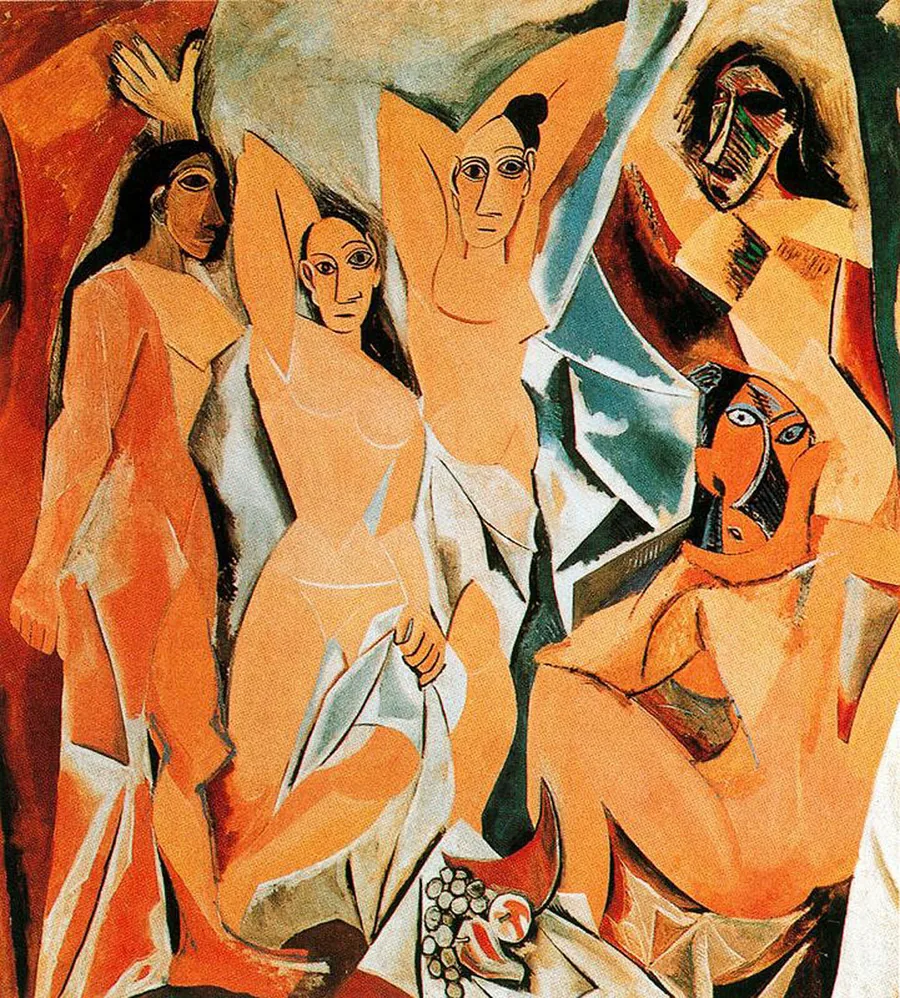
Picasso, Les Demoiselles d'Avignon
Picasso, Les Demoiselles d’Avignon, 1907 — among the algorithm’s top picks ten years ago, and still.
TL;DR

In 2015, Ahmed Elgammal and Babak Saleh at Rutgers asked a question that sounded almost willfully naive: can you measure creativity? Not the felt experience of it, or the cultural reception, but a structural property of an artifact, computed from its relation to everything painted before and after it. Their algorithm, knowing nothing about art history, ranked Munch’s Scream, Goya’s Christ Crucified, and Malevich’s Red Square among the most creative paintings in the canon. MIT Technology Review covered it under the headline “Machine Vision Algorithm Chooses the Most Creative Paintings in History.”

Pulling that off in 2015 took a research lab working at the edge of what machine vision could do. There were no foundation models. Elgammal and Saleh represented each painting with Classemes, hand-engineered features built from thousands of object detectors, and getting a computer to say “these two paintings look alike” was itself a contribution. I read the paper in college and it stayed with me.

Ten years later, the expensive part is the cheap part. A self-supervised network will look at 36,000 paintings in half an hour and hand back, for each one, a representation rich enough that nearest-neighbor search finds paintings by the same artist, in the same mood, decades apart. So I re-ran the experiment. Same algorithm, modern eyes. One weekend, about $100, most of it running while I did other things.

What follows is what it found, what it got wrong, and why the interesting question turned out not to be is this painting creative? but who decided what “similar” means?


Creativity as a structural property

The paper’s definition has two parts. Originality: this work does not look like the work that came before it. Influence: the work that came after it looks like this. A painting is creative when both hold at once. Eccentric alone doesn’t count, and neither does popular; the score rewards the conjunction.

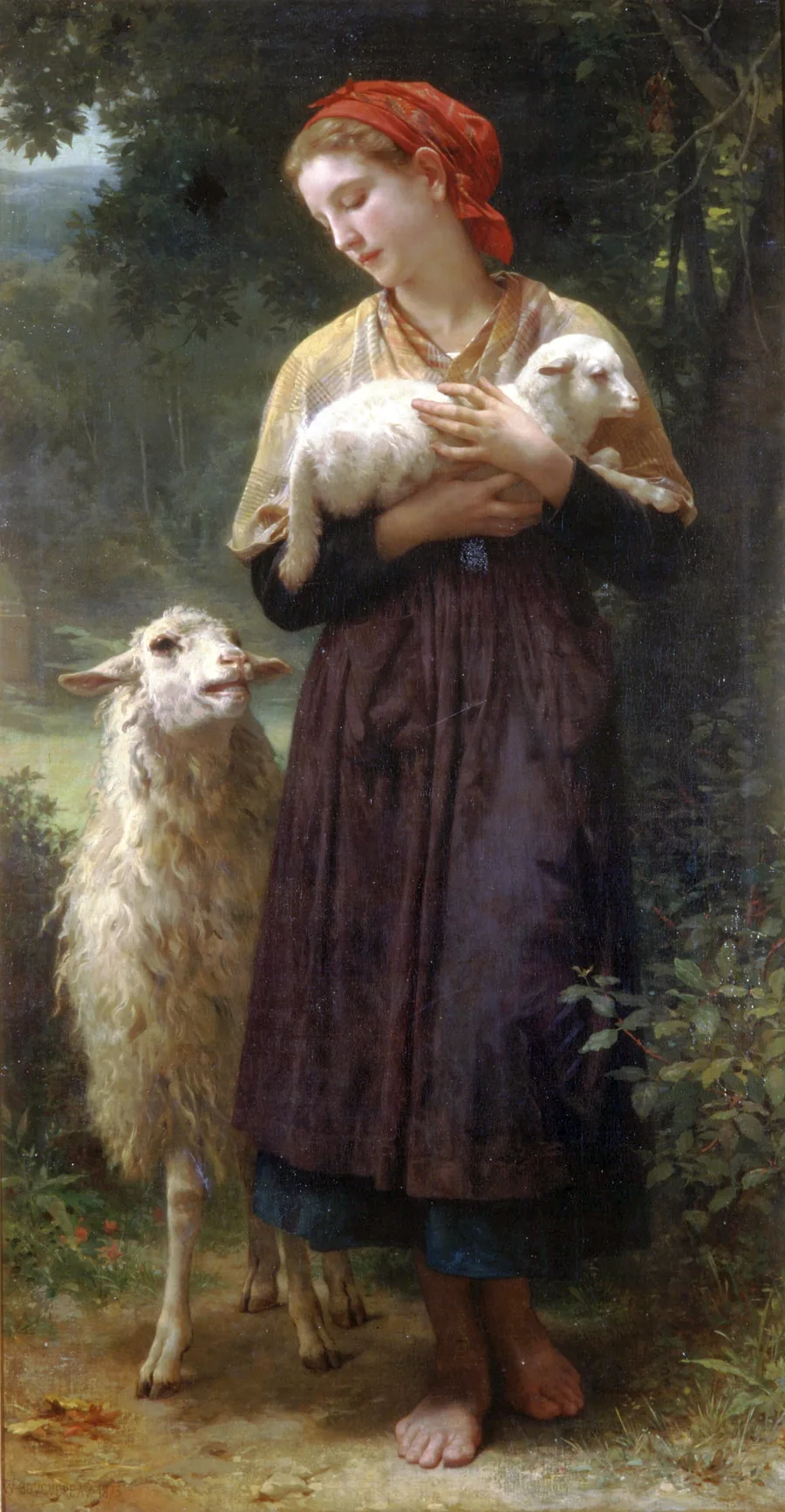
Bouguereau, The Shepherdess, 1873
A follower. Bouguereau, The Shepherdess, 1873. Polished, popular, conventional; structurally indistinguishable from a hundred others of its decade.
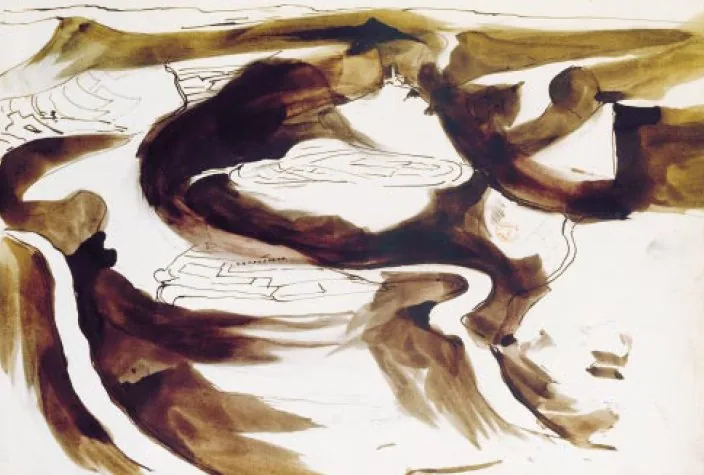
Victor Hugo, Our Valley, 1871
An eccentric. Victor Hugo, Our Valley, 1871. Visually radical for its moment, but few painters built on its ink-blot abstraction. Original without lineage.
Picasso, Les Demoiselles d'Avignon, 1907
A creative work. Picasso, Les Demoiselles d’Avignon, 1907. Unlike its predecessors. Echoed by everything after.

How the algorithm sees a painting

Before measuring creativity there is a smaller question to settle: when are two paintings similar? The algorithm doesn’t answer this itself. It outsources the question to a foundation model.

Step 1 · A painting becomes a pattern of 1,024 numbers

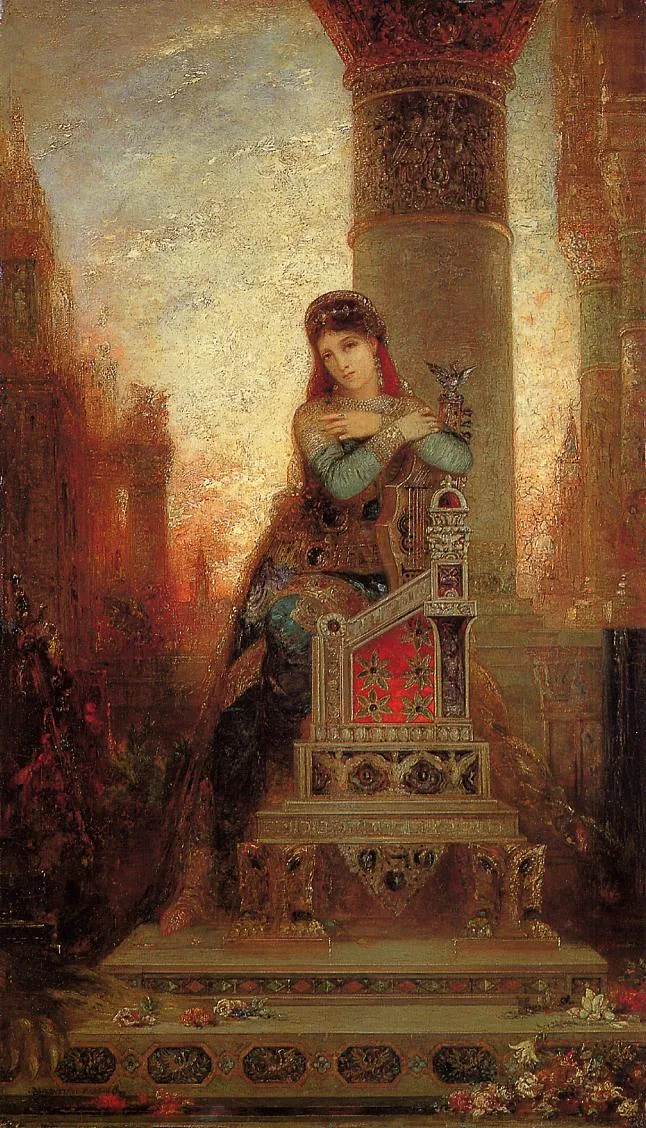
Moreau, Desdemona
Moreau, Desdemona
1875
DINOv2 embed
Picasso, Demoiselles
1907
DINOv2 embed
Different paintings produce different patterns. Each cell stands in for one of the 1,024 dimensions, shaded by the painting’s value on it. The pattern is the painting’s coordinates in feature space.

Step 2 · Similarity is the overlap between two patterns

Moreau, Desdemona
Moreau, 1875
cosine similarity 0.73 visually related
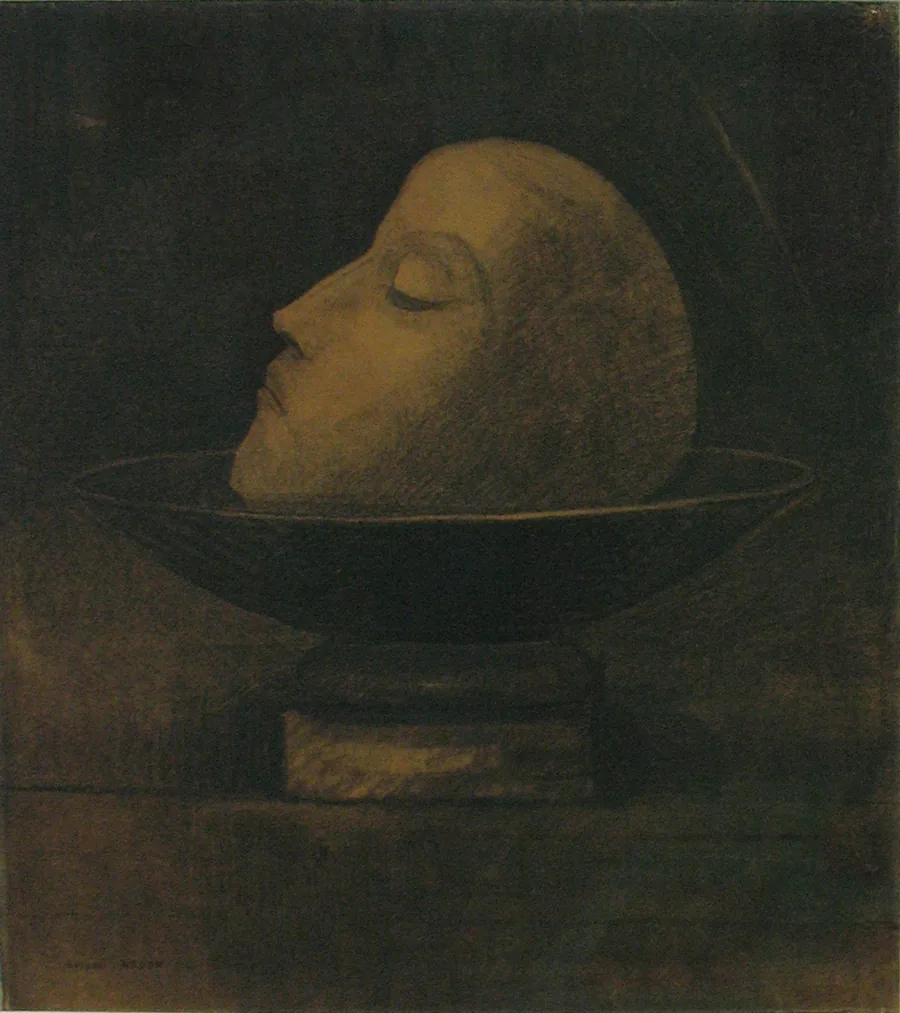
Redon, Head of a Martyr
Redon, 1877
Two Symbolist heads produce overlapping patterns; the model has placed them near each other in its space. A landscape or a Pollock would barely overlap either, and the similarity would fall toward zero. This single number, computed for every pair of paintings, is everything the algorithm has to work with.

This is the part that was impossible in 2015. DINOv2 was never shown a label about art history and was never told who Picasso was. It was trained on 142 million images to fill in masked patches and to recognize different crops of the same picture. The representation that falls out organizes paintings by texture, composition, and palette, the properties that separate a Symbolist canvas from an Abstract Expressionist one, without anyone explaining the difference.

A creative painting in the similarity graph PREDECESSORS few faint links → the anchor SUCCESSORS many strong links from anchor → 1620 1769 1840 a creative painting 1875 1882 1895 1901 1910 1925 1940 predecessor sim ≈ 0.3 successor sim ≈ 0.7 1400 1500 1700 1875 1900 2000 TIME →
Originality = how unlike its predecessors (few faint backward links). Influence = how similar its successors are (many strong forward links).

Originality is one minus the mean similarity to predecessors. Influence is the mean similarity to successors. Both are converted to percentiles within a 150-year window around each painting, so a 1450 work is compared to 1375–1525 works rather than to all of art history, and then multiplied. The result is a number between zero and one. Higher means the painting did something its predecessors hadn’t, and its successors picked it up.

Originality O(p) = 1 − meanq ∈ pred(p) sim(p, q)
Influence I(p) = meanq ∈ succ(p) sim(p, q)
Windowed rank Õ(p) = pctq ∈ W75(p) O(q) ≤ O(p)
Creativity C(p) = Õ(p) · Í(p)

pred and succ are the 500 nearest forward-in-time neighbors of p in the embedding graph; sim is cosine similarity; W75(p) is the ±75-year window around p’s date. The windowed rank removes a bias where older paintings look influential just because more of the corpus comes after them.


What I ran

Eight steps, about $100 all-in, four hours of wall clock with most of it running in the background:

  1. Scrape. 34,073 paintings from WikiArt (all 27 style listings), 1,831 from the Met’s open-access catalog, 98 from the Art Institute of Chicago. Drop anything without a parseable year. Final corpus: 36,002 paintings, 110–2022.
  2. Embed. Run every image through DINOv2-large on a rented GPU; each painting becomes a 1,024-dimensional vector. About thirty minutes. Repeat with OpenCLIP, SigLIP, DINOv3, and DreamSim for the cross-model comparison.
  3. Build the graph. For each painting, find its 500 nearest neighbors in embedding space and keep only the edges that point forward in time. 7.7 million edges over the 36,000 nodes.
  4. Score. Originality, influence, windowed percentiles, multiply.
  5. Clean. Remove mosaics, architectural drawings, and near-duplicates. Cap the displayed rankings at three works per artist so the top 50 isn’t five Van Eycks in a row.
  6. Validate causally. The paper’s “time machine” test: re-score 300 paintings with their dates shifted by a hundred years. Moved later, a creative painting’s score should collapse, because its innovations are now old news; moved earlier, it should hold. It does: −0.129 shifted later, +0.002 shifted earlier, consistent across all five score quintiles.
  7. Validate against the canon. Take the top 200 and bottom 200 of the ranking. For each painting, ask Claude, from the title, artist, and year alone, no image, whether the work is generally considered innovative or influential in art history. Compare the two rates.
  8. Train a surrogate. A small network trained on (embedding, year) reproduces the graph score with rank correlation 0.86 on held-out paintings, so a new image can be scored without rebuilding the graph.

Code and result files: github.com/tnisbet/art-creativity. The pipeline runs on serverless GPUs billed by the second; the whole thing, five embedding models included, cost about $100. The 2015 version needed a lab. This one fits in a weekend.


The top of the list, ten years later

Most of the faces at the top of the 2026 ranking are familiar. Symbolists (Moreau, Redon, Böcklin, Vrubel, Khnopff) dominate the top 200. Early Netherlandish breakthroughs, Campin’s triptychs and Van Eyck’s portraits, cluster at one peak; modernist ruptures, Kandinsky’s first abstractions and Ernst’s earliest experiments, at another. Nobody told the algorithm any art history, and it finds many of the places art historians point to.

The #1 painting is one you’ve never heard of

Look at the first card, though. The highest-scoring painting in the corpus is not a Moreau or a Van Eyck. It is Night at the Cervantes Theater in Tangier, painted in 2001 by Consuelo Hernández, a living Spanish realist who appears in no survey text. Her other theater interior is second.

This is an artifact of the corpus edge, and it is worth understanding because it shows exactly how the score fails. Influence is measured over successors, and a painting from 2001 barely has any: the corpus thins to a few hundred works per decade after 2000, so the forward half of her 150-year window mostly hasn’t happened yet. A handful of chance resemblances in that thin slice can hand a recent painting a near-perfect influence score. I could have filtered the list to pre-2000 work and shown you a cleaner top ten. Better to show the real output: at the edge of the timeline the score is waiting on a future that doesn’t exist yet, and a confident number there means very little.


The shape of creativity

With a score on every painting, you can ask how creativity is distributed. Are some centuries more creative than others? Some decades? Some styles?

The flat curve

Mean creativity per century is remarkably steady. The 15th: 0.198. The 16th: 0.198. The 17th: 0.185. The 18th: 0.192. The 19th: 0.196. The 20th: 0.205. The 21st (partial): 0.228. Slightly higher in modern eras, but the differences are small, 0.04 across six hundred years.

Mean creativity per century. The y-axis is zoomed to 0.15–0.25 to make the differences visible at all; in absolute terms the curve is nearly flat.

There is no golden age. The algorithm finds creative work roughly uniformly across six centuries, which is itself a claim about how to think about creativity. The original, history-bending work is not the property of an epoch. Each generation produces its handful of structural pivots and its overwhelming majority of conventional inheritors.

The decade peaks

Zoom in from centuries to decades and the curve is no longer flat. Specific decades stand out from their neighbors, not by enormous margins but consistently, and at moments where art historians would expect to see something.

Mean creativity per decade, 1430–2010. Labeled bars mark the five decades the algorithm rates most distinctive: 1430s, 1710s, 1910s, 1940s, 2010s. (The 2010s peak is the corpus-edge artifact from the previous section.)

The four historical peaks land where visual vocabulary actually shifted: the 1430s (oil technique and domestic realism arriving in the North), the 1710s (Watteau inventing the fête galante, Rococo emerging out of Baroque grandeur), the 1910s (Picasso, Kandinsky, and Malevich breaking representation within a few years of each other), the 1940s (the New York School). And they divide into two kinds. The 1910s and 1940s are loud: they announced themselves as revolutions, with manifestos, and show up exactly where the textbooks say. The 1430s and 1710s are quiet. Van Eyck perfected oils rather than inventing them, a substrate-level innovation whose effects are everywhere and unannounced; Rococo was dismissed by later critics as decoration. The algorithm sees only what survived and what got copied, and by that measure the quiet pivots are as creative as the loud ones.

What strikes me is that it finds all four from pixels alone. It has no concept of a movement, a school, or a manifesto. It only notices when many works stop looking like the decade before them and the decades after start looking like them. All four peaks carry that signature. Only two got the mythology.

Which styles win?

The decade view sorts by time; the style view sorts by category. Both point the same way.

The algorithm has clear preferences: Color-Field Painting, Abstract Art, Surrealism, Cubism, Symbolism. Visually radical movements win. Impressionism and Rococo land mid-table; they introduced techniques, but their visual vocabulary stayed legible against what came before. Realism, Neoclassicism, and Baroque fall to the bottom. Conceptual Art, tellingly, lands dead last: when the meaning of a work is in the idea rather than the image, DINOv2 has nothing to hold on to. Keep that one in mind; it comes back later.

The Symbolist surprise

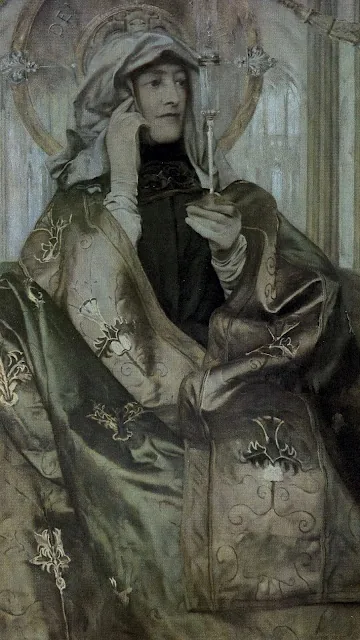
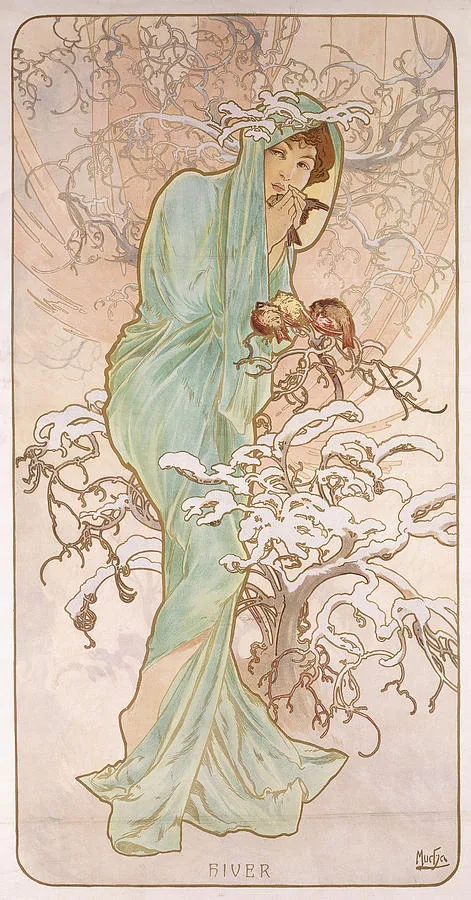
One artist dominates the top of the ranking like no one else. The most-represented painter in the top 200 is Gustave Moreau, with 21 paintings. Odilon Redon has 10. Add Arnold Böcklin, Mikhail Vrubel, Fernand Khnopff, and Alphonse Mucha, and the late-19th-century Symbolists become the densest cluster of “creative” work in the corpus.

The Symbolists are the most creative artists in the corpus. Not because they’re the most beloved, but because they’re the most structurally pivotal.

This is not what the popular canon predicts; Cézanne and Picasso loom larger there. But it is consistent with the algorithm’s logic. The Symbolists were the bridge between 19th-century academic painting and 20th-century surrealism: visually radical for their moment and echoed by what came after. That is precisely the conjunction the score rewards.

When I went looking afterwards, the art-historical consensus was there waiting. Facos and Mednick’s The Symbolist Roots of Modern Art (Routledge, 2015) argues that “Symbolist approaches to content, form, and subject helped to shape” twentieth-century Modernism, tracing the line through Kandinsky, Khnopff, Munch, and lesser-known figures like Vrubel. That view is standard in the specialist literature and systematically underweighted in the textbook chronology, which prefers the clean Impressionism → Post-Impressionism → Cubism arc. The algorithm has never seen a textbook. It reads only the pictures, and the pictures tell the specialist’s story.

The Moreau result in particular has a one-line resolution. From 1892 he taught at the École des Beaux-Arts, and his students included Henri Matisse, Georges Rouault, and Albert Marquet, the leading Fauves. The algorithm picked him up at the root of the Fauvist branch by detecting the visual through-line from teacher to students. It took the Anglo-American canon until MoMA’s 1961–62 Redon–Moreau–Bresdin exhibition to begin recovering him. The algorithm gets there from pixels, with no curator.

Moreau, Desdemona
Moreau, Desdemona, 1875
Redon, Head of a Martyr
Redon, Head of a Martyr, 1877
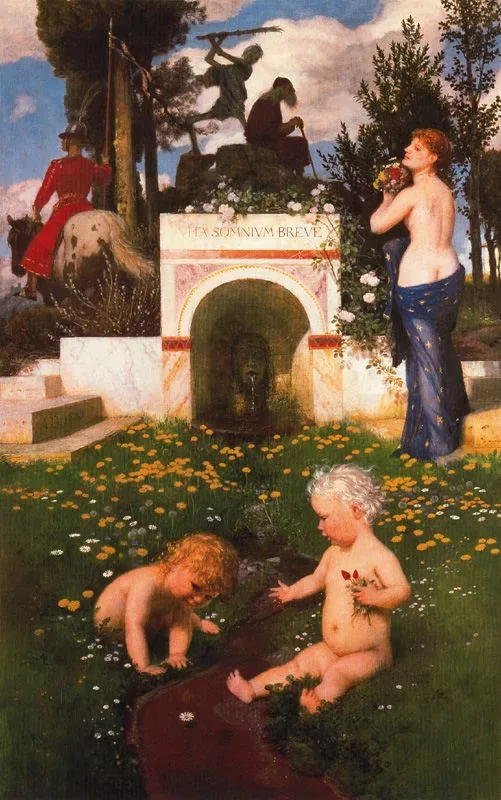
Boecklin, Vita somnium breve
Böcklin, Vita somnium breve, 1888
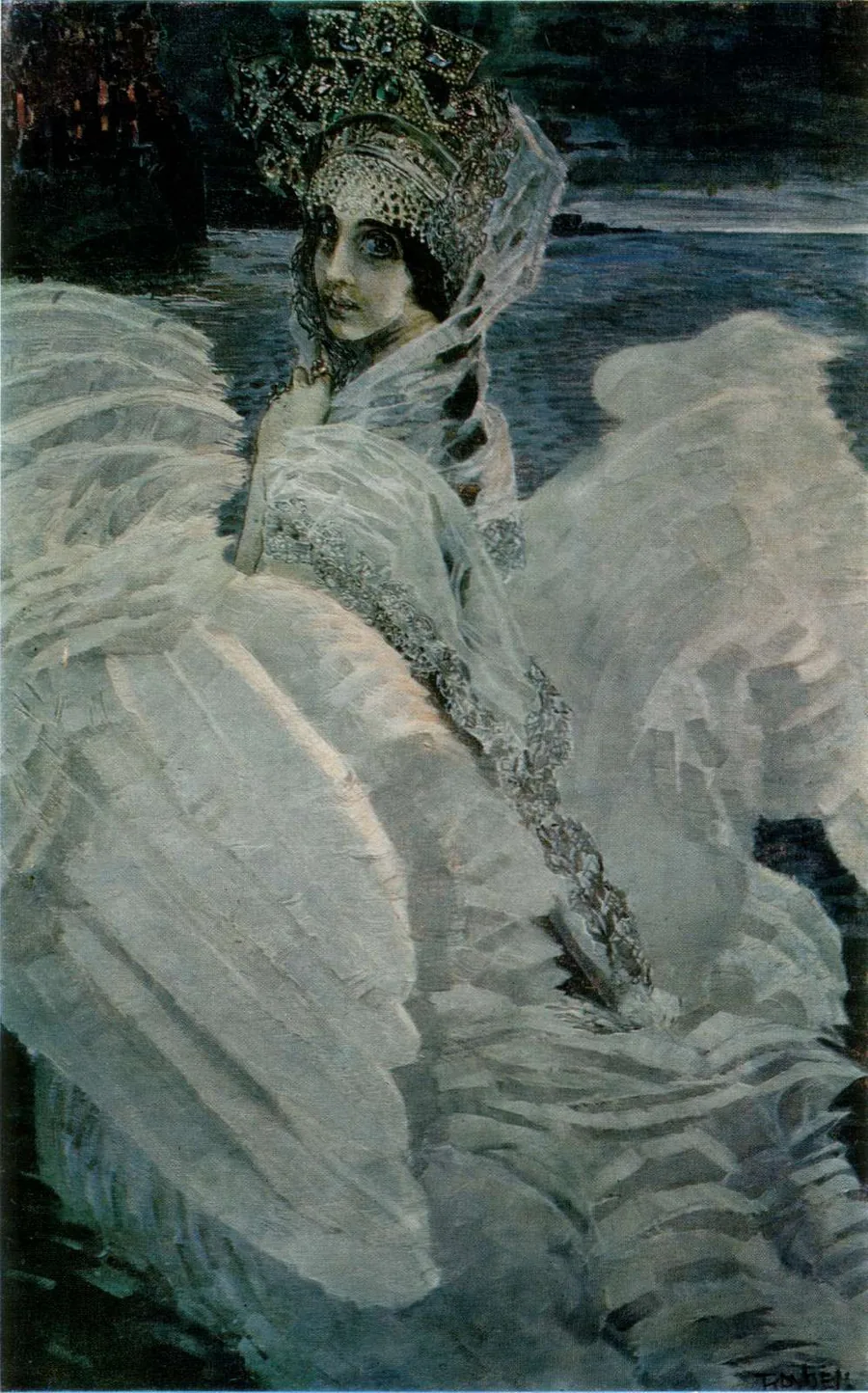
Vrubel, The Swan Princess
Vrubel, Swan Princess, 1900
Khnopff, Incens
Khnopff, Incens, 1898
Mucha, Winter
Mucha, Winter, 1896

Four kinds of paintings

Split originality and influence at their medians and the corpus falls into four populations.

High originality, low influence Eccentric 43.4% of paintings

Original without lineage. Van Eyck’s Arnolfini actually lands here; its influence is too genre-specific for the embedding to register.

High originality, high influence Creative 6.6% of paintings

The rare conjunction. Different from what came before, echoed by what comes after.

Low originality, low influence Forgotten 6.6% of paintings

Derivative and uninfluential. Most painters work here, by definition, most of the time.

Low originality, high influence Derivative but popular 43.4% of paintings

Conventional works with many visual descendants; competent inheritors of a style.

The Van Eyck problem. A painting can be historically influential in ways the embedding cannot detect. Van Eyck’s innovations in oil glazing, perspective, and the merchant interior ramify through five centuries of Western painting, and DINOv2 doesn’t see it, because the influence runs through technique and genre rather than surface resemblance. The algorithm’s blind spots are also a portrait of what foundation models do and don’t see.


What it sees when it calls a painting creative

Every score the algorithm produces is checkable. When it calls a painting original, it is claiming the three closest predecessors don’t look like it, and you can look for yourself. When it calls a painting influential, same thing: here are the successors it picked. The score is a summary over hundreds of such comparisons, but the comparisons are visible.

One thing to watch for below: the graph has no concept of authorship, so an artist’s closest successors are often themselves. Moreau’s row is honest about this; his three nearest successors are three more Moreaus. Prolific painters are their own best imitators, which is exactly why the displayed rankings cap each artist at three works.

Three closest predecessors
what it claims not to look like
The work
Three closest successors
what inherited from it

The model is the aesthetic theory

Everything above comes from DINOv2, a self-supervised model. How much of it survives a change of eyes? To find out, I re-embedded the same 36,000 paintings with OpenCLIP, a contrastive image-text model (the CLIP ViT-L/14 checkpoint), trained not to reconstruct images but to match them with captions. Then I ran the same algorithm, top to bottom.

The two rankings barely agree. Rank correlation on creativity: 0.20. Overlap in the top fifty paintings: one.

What DINOv2 sees as creative, OpenCLIP doesn’t
What OpenCLIP sees as creative, DINOv2 doesn’t

Look at the rows. DINOv2’s picks share a visual signature: dense surfaces, jewel-like color, visionary subject matter. Symbolist surfaces. OpenCLIP’s picks share a different one: technical mastery in rendering recognizable subjects. Venetian view-paintings, court portraits, motion studies. The disagreement is structured, not random. A model trained to reconstruct images keeps texture, composition, and palette; a model trained to match captions keeps what a caption would mention, the things in the picture and the kind of scene. They are not measuring the same notion of similarity, so a creativity score built on similarity cannot come out the same.

A third model, SigLIP, another image-text variant, agrees with neither: its rank correlation with DINOv2 is 0.00 and with OpenCLIP 0.03. Three models, three essentially independent orderings of the same 36,000 paintings.

So, is any of them right? I put the question to an outside judge. For the top and bottom of each model’s ranking, Claude read the title, artist, and year, nothing else, and answered whether the work is generally considered innovative or influential in art history. To sharpen the comparison I also ran two newer models through the whole pipeline: DINOv3 (Meta’s August 2025 successor to DINOv2, six times the parameters) and DreamSim (an ensemble of CLIP, OpenCLIP, and DINO fine-tuned on human similarity judgments). This table is the headline of the whole project.

ModelTop % innovativeBottom % innovativeGap95% CIVerdict
DINOv3 self-supervised, 202564.0%46.7%+17.3pp[+6.0, +28.7]validated
DINOv2 self-supervised44.5%25.5%+19.0pp[+9.5, +28.0]validated
DreamSim human-aligned ensemble50.0%32.0%+18.0pp[+7.3, +28.7]validated
OpenCLIP image-text contrastive41.3%56.7%−15.3pp[−26.7, −4.0]anti-validated
Four foundation models, same pipeline, same paintings. Claude judges each painting from title + artist + year alone. Top % is the share of the model’s top 150–200 judged innovative; Bottom % the same for its bottom. Gap is top minus bottom, and the bracket is a 95% confidence interval from 10,000 bootstrap resamples: the range the gap stays inside if you re-draw the sample over and over. Three models surface paintings the judge recognizes as innovative. One surfaces paintings it considers less innovative than its own bottom of the barrel.

Read it from the top. DINOv3 produces the most striking list: nearly two-thirds of its top 150 are recognized as innovative. DINOv2 has the cleanest separation between its top and bottom. DreamSim, an ensemble of the other families reweighted by human judgment, reproduces the result, which says this isn’t a quirk of one network. And then there is OpenCLIP, which is not measuring something different so much as something inverted: it promotes accomplished, conventional work, the kind an art historian would admire and file away, and its gap is reliably negative.

This is a harder claim than “different models give different answers.” Three of the four align with the art-historical record and one inverts it, and what separates the two groups is the training objective. The models that validate all learned from images alone. The one that fails learned by matching images to captions. Choosing an embedding is not a technical detail. It is a bet on what counts as a meaningful difference between two pictures, and some bets lose.

The embedding model is the implicit aesthetic theory. And not all aesthetic theories survive contact with the canon.

Why self-supervision wins

The mechanism isn’t mysterious. A model trained to match pictures with captions keeps what a caption would mention, the subject, the era, the kind of scene, and learns to discard what a caption wouldn’t. But much of what art historians mean by innovation is exactly what captions leave out: brushwork, palette, compositional rhythm, the grain of a surface. Researchers who build style-similarity models describe the standard pipelines the same way: content is preserved, style is treated as noise. DINOv2’s training involves no text at all. To fill in masked patches and match crops of the same image, its representation has to keep texture, color, and composition, which is far closer to what a historian uses when tracing who learned what from whom. Meta’s own claim for DINOv3 is the general version: “for the first time, a model trained with SSL outperforms weakly-supervised models on a broad range of probing tasks.” In this corner of the world, the pattern shows up as +19 points for the self-supervised model and −15 for the image-text one.

Two loose ends, flagged plainly. SigLIP was scored but never judged: by the time I ran the four-model comparison the judging budget was spent, so it is absent from the table above. Its ranking correlates with nothing, including its fellow contrastive model, and my bet is it lands on OpenCLIP’s side, but that is a bet, not a result. And the strongest version of this experiment wouldn’t use general-purpose backbones at all. Embeddings built specifically for artistic style exist, trained to keep the brushwork and discard the subject, the inverse of the standard recipe (CSD, ALADIN). That the result is already this clean with off-the-shelf models suggests the signal is real; art-specific models should sharpen it.
Would this work on music, papers, code?

Strip away the paintings and the algorithm is a recipe: take a domain where things have dates, embed each thing in a space where similarity means something, build a forward-in-time graph, score originality times influence. Nothing in that is specific to art. What changes by domain is which pieces you get for free and which break.

Science is the closest analogue. Papers have exact dates, embeddings trained for the task (SPECTER learns from citation relatedness), and a citation graph that makes influence partly observable, a luxury art never gets. Pieces of the idea exist in the bibliometrics literature: novelty scored as the semantic distance between a paper’s references, models that flag papers which “look younger” than their publication date, which is operationally the same as “your embedding resembles the future.” What I haven’t found is anyone running this exact recipe over a full corpus like Semantic Scholar’s 200 million papers. The output would be a ranking of papers that introduced something the literature later organized itself around. My guess is the top would hold the canonical field-founders, and next to them, under-cited work whose ideas got absorbed into more famous papers. That second list is the one worth having.

Music is partway there. Audio embeddings exist (CLAP and friends), and researchers have already built similarity graphs over millions of clips to attribute what a generative model borrowed from its training data, this score’s influence arrow pointed backwards. Dating recorded music from 1900 on is easy. The hard part is validation: art history hands you a canon of “innovative” works to check against, and music criticism has nothing quite as settled.

Code is open territory. Run the recipe over npm or PyPI with a code embedding and ask which packages introduced conventions that later packages cluster around. I would bet on jQuery, requests, numpy, and express surfacing at the top of their eras, alongside unsung libraries whose ideas were copied into more famous ones.

The limitation is the same one everywhere, and it is the theme of this essay: the algorithm is only as good as its notion of similar. In painting, perceptual distance tracks stylistic kinship well enough to work. In code, syntactic similarity finds copy-paste lineage but misses conceptual influence entirely; whoever invented dependency injection wrote no code that looks like the millions of files that later adopted the pattern. In music, raw acoustic distance is weakly tied to what musicians actually inherit from each other. The recipe transfers. The similarity metric has to be rebuilt each time, and each rebuild smuggles in a theory of what counts as influence in that field.


The algorithm and the canon barely agree

If the score is recovering something real, it should track what historians and collectors have already canonized. I tested this with Parallel’s enrichment API, running two passes over the top 200 artists in the DINOv2 ranking: one for biography (birth and death years, nationality, movement, how they trained, Wikipedia article length), one for the market (peak auction record, estimated annual auction volume, Google Arts & Culture presence, major retrospectives).

Every fame proxy correlates with the creativity score, weakly. The statistic here is Spearman’s ρ, a rank correlation: +1 means two rankings agree exactly, 0 means they are unrelated. Auction volume, retrospectives, peak auction record, and Google Arts & Culture all sit between +0.13 and +0.16. Wikipedia article length sits at +0.02, indistinguishable from zero. A composite of all five: +0.16.

+0.16
Composite fame (5 proxies); 95% CI [+0.01, +0.30]
+0.16
Annual auction volume; CI [+0.01, +0.30]
+0.02
Wikipedia article length; CI [−0.11, +0.16]

The honest read: the algorithm and the canon overlap faintly. If visual creativity were fame in disguise, these numbers would sit near +1. At +0.16, fame explains about 2% of the variance in the score. Part of the reason is that the proxies barely agree with each other; auction record and Wikipedia length correlate at just +0.27, so “fame” is not one signal but several institutions canonizing different artists. Mostly, though, the algorithm is measuring something the institutions don’t.

Top 200 artists by DINOv2 creativity score. Each point is one artist: x = creativity score, y = composite fame index (the averaged z-scores of five fame proxies). Symbolists in terracotta; hover any point for the artist and their numbers. Spearman ρ = +0.16, 95% CI [+0.01, +0.30]. Enrichment via Parallel, May 2026.

One data note: 67 of the 200 artists show a six-figure auction record but zero annual volume, Kandinsky and Ernst among them, which is a source mismatch in the enrichment rather than a fact about the market. Excluding them nudges the volume correlation from +0.16 to +0.20 and changes no conclusion.

Self-taught artists score higher

The biographical pass also tagged how each artist trained. Self-taught painters are a small minority of the top 200 (20, against 138 academy-trained and 37 apprenticed), but they score meaningfully higher:

The cells are small enough that the right read is qualitative: the top tail leans toward artists outside the salon-and-academy pipeline. That matches the movement-level pattern; Symbolism, Magic Realism, and Surrealism grew largely outside the academic system.

Under-valued by the market

Thirty-two artists sit in the top half of creativity and the bottom quarter of auction records. Some are medieval masters whose work lives in permanent collections and rarely trades. One is the corpus-edge artifact you already know. The rest are candidates for genuine under-recognition: painters whose visual innovations the algorithm detects and the market has not priced.

ArtistMovementCreativityAuction record

The right reading of this section is neither “the algorithm is right and the canon is wrong” nor the reverse. They are weakly, positively related, and the weakness is the finding: the score is picking up something different from market value or institutional prestige. The next section is about what that something cannot see.


What pixels and dates cannot see

The blind spots deserve equal time, because the biggest category of error here is structural. Better embeddings will not fix it.

Conceptual innovation is invisible

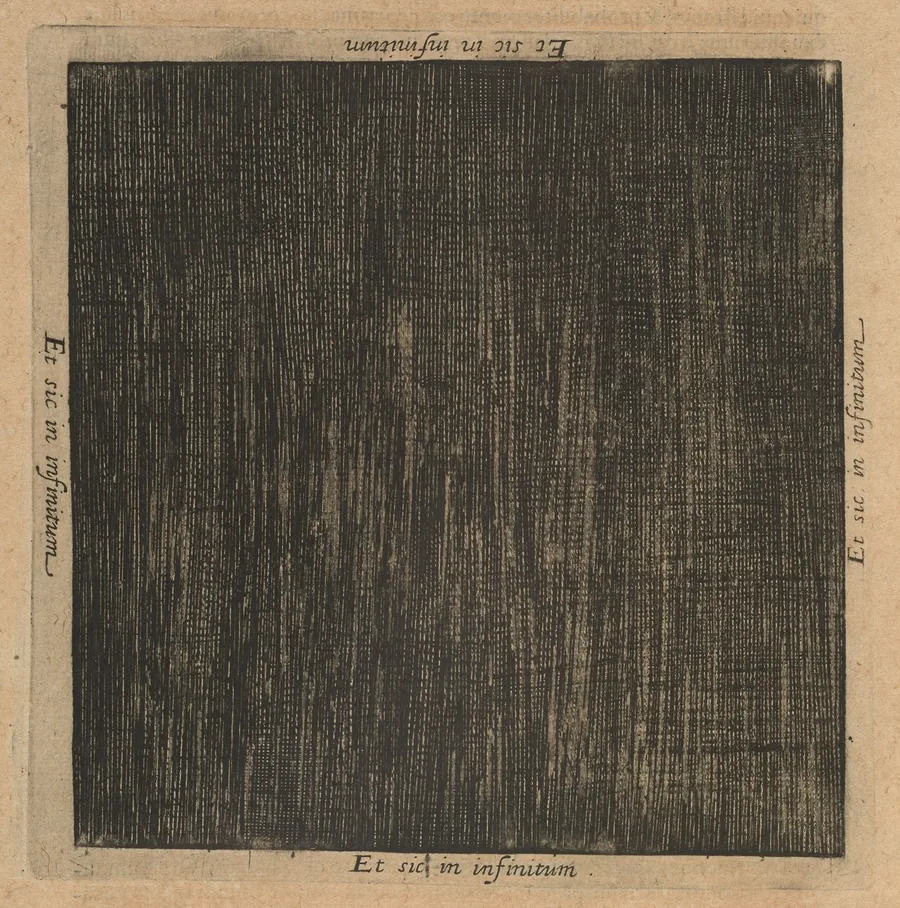
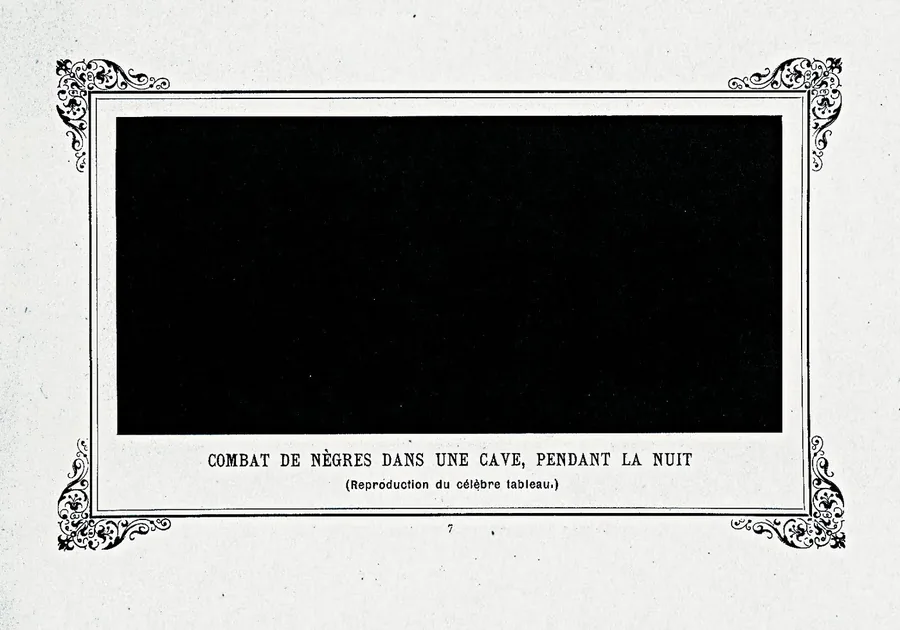
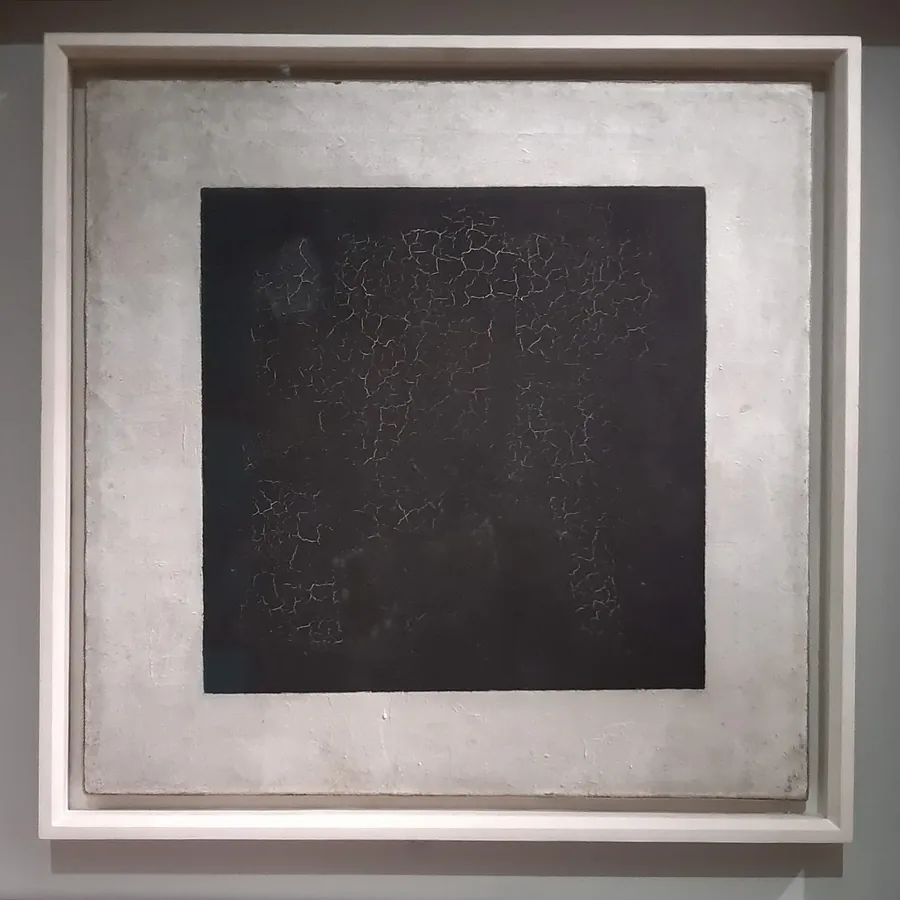
The clearest case is Malevich’s Black Square (1915), often called the founding work of pure abstraction. As the Public Domain Review has documented, visually near-identical black squares had been painted for centuries before it, including a 1617 diagram in Robert Fludd’s Utriusque Cosmi and Alphonse Allais’s 1897 monochrome joke. Three nearly identical images, three centuries apart. One founded abstraction. The other two are a diagram and a punchline.

A pure visual-similarity algorithm has to rate Malevich as unoriginal, since his canvas resembles earlier work, and the joke as creative. That inverts the historical judgment, and the missing variable is the philosophical claim Malevich attached to the canvas. Duchamp is the same case made deliberately: he chose his readymades for their visual indifference, the idea first, the retinal experience beside the point. A creativity score built from retinal features is blind to anti-retinal art by construction. Klein’s monochromes, Cage’s silence, most of conceptual and performance art: the algorithm cannot see what isn’t on the canvas. This is why Conceptual Art finishing dead last in the style rankings is not a quirk. It is the same blindness, measured.

Influence is not similarity

The graph treats “looks like a later painting” as evidence of “influenced that later painting.” But resemblance also comes from shared sources, from zeitgeist, from coincidence. Two painters who each studied Cézanne will produce work that looks alike, and the algorithm will record an edge between them. Every documented case of influence and every accidental visual rhyme are identical at the level of cosine similarity. This is the framework’s largest source of systematic error, and it is the move art historians push back on hardest; Sonja Drimmer’s recent Artforum critique of AI-as-art-historian is the sharpest version of the objection.

What the corpus cannot hold

Influence also travels through channels no image corpus contains. The avant-gardes were built as much from manifestos and teaching as from paintings: Marinetti’s Futurist manifesto, the Bauhaus syllabus, Malevich instructing Lissitzky. Duchamp’s Bicycle Wheel fathered two whole approaches to sculpture. None of that is in the pixels. And the corpus itself is a point of view. WikiArt supplies 95% of the images here, its coverage is uneven, and, as Amanda Wasielewski argues in Computational Formalism (MIT Press, 2023), datasets like it quietly re-encode the traditional Western canon. Innovations from African, Islamic, East Asian, and Indigenous traditions that did not feed into this corpus score as peripheral by construction; the algorithm cannot find what isn’t there. Survivorship bias compounds it: the Stalinist suppression of the Russian avant-garde removed what would have been the predecessors of mid-century abstraction, and the graph treats the absence as if it never existed.

What this means for the result

The Symbolist finding is, I think, real and interesting. But the right way to read the output is not as a creativity oracle. It is a measurement of one specific kind of lineage, the kind visible when surface resemblance is all you can see. The original paper said this plainly, in a sentence I keep returning to: “A low creativity score does not mean that the work is not creative in general, it just means that the algorithm does not see it creative with respect to its encoding of subject matter and composition.” Ten years and much better encodings later, the sentence still holds.


The embedding is doing the philosophy

The result that mattered in 2015 was that an algorithm with no historical knowledge could recover the canonical judgment. The 2026 version sharpens it: four foundation models, three validations, one inversion, and the split runs exactly along the training objective. The finding is not fragile. But the texture of what counts as creative belongs to the representation, not to the algorithm.

The structural claim underneath is the one I find myself believing. A creative painting introduces a new visual primitive: originality is the cost of describing it given everything that existed, influence is the savings in describing everything that came after. That framing is compression, a thread I keep pulling on, and it is why I think the recipe travels beyond art: a creative work, in any medium, is one that changes how cheaply the future can be described.

The Symbolist result is the one I keep coming back to. I did not predict it, and the algorithm did not know what a Symbolist was. Yet the structural signature it rewards, original against predecessors and foundational for successors, surfaces the exact artists that specialists now argue were the quietly important ones. If a model with no labels reliably finds them, it is worth asking what else the geometry of these representations knows that we haven’t asked for.

And there is a quieter lesson in the receipts. The 2015 experiment sat at the frontier of computer vision: custom features, a research group, a result striking enough for the press. The 2026 version was a coding agent, off-the-shelf embeddings, and serverless GPUs rented by the second, about $100 in total, and most of the weekend went to thinking and writing, not engineering. Teaching a machine to see was the hard part, and it is now an API call. In plain terms, the bottleneck has moved from building perception to choosing what to measure. The binding constraint on this kind of research is no longer compute or infrastructure; it is having an interesting question to ask. Anyone can now rank 36,000 paintings by any visual theory they can name, and the scarce skill is noticing that the choice of model is the theory, because nothing forces you to state it out loud. It also means decade-old computational results are no longer papers to cite but afternoon experiments to re-run, in art history and in every domain a section above touched, and some of them, re-run, will say something different. A small example, but I don’t think an isolated one.

The most surprising thing this project taught me is that creativity, measured this way, is not a property of an artwork. It is a property of an artwork under a representation. Run the algorithm with a self-supervised model and the Symbolists rise; run it with an image-text model and the view-painters do. Both lists are defensible. Neither is right. The model does the philosophy quietly, in the weights, and the least we can do is choose it out loud.